Why a Frozen Kong Is the Preferred High-Value Chew for Crate Training
Crate training works best when the crate is paired with something high value — something the dog only gets there. When that pairing is consistent, the crate stops predicting separation and starts predicting calm, settling, and focused engagement. That idea is foundational, and it’s one we cover in our Crate Training 101 framework. One of the most common follow-up questions I get after people read that article is what high-value chew I actually use during crate training.
A lot of chews can be useful in the right context.
Raw bones can be great for teeth.
Bully sticks can keep dogs deeply engaged during supervised chew sessions.
But crate time is different.
When a dog is alone or unsupervised, the rules change.
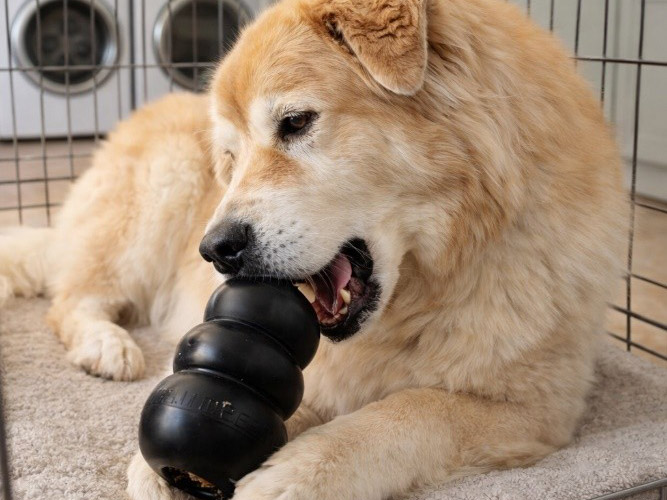
Many popular chews shrink as a dog works on them. Once the remaining piece gets small enough, some dogs will try to swallow it — which creates unnecessary risk during unsupervised crate time. For that reason alone, many otherwise “good” chews don’t belong in the crate. That’s why I use a frozen Kong for crate training.
The three main reasons are:
- long-lasting
- engaging
- designed to be safe when a dog is unsupervised
A properly sized rubber Kong holds its shape, which makes it far safer than chews that break down or become swallowable. It also lets me control what my dog is eating, since I can use my dog’s regular food or simple additions instead of relying on highly processed chews.
But the part that really matters for crate training is what comes next.
Why Freezing the Kong Makes Such a Difference
Freezing the Kong is what turns it from a short distraction into a long-lasting, settling activity.
When a Kong isn’t frozen, many dogs can empty it quickly. Fast consumption doesn’t help a dog relax — it just ends the activity.
Freezing changes how a dog interacts with the food inside. Instead of chewing and finishing quickly, the dog has to work steadily at the contents — similar to working marrow out of a real bone.
That slow, repetitive effort:
- keeps the dog engaged longer
- supports calmer behavior
- helps the dog actually settle during crate time
This becomes especially important during longer crate sessions or anytime you’re leaving the house. The frozen aspect is what allows the Kong to last long enough to support settling, not just occupy the dog for a minute or two.
(By the way, if you’re unfamiliar with the Kong toy – here’s quick a link for you to check it out CLASSIC RED KONG )
Choosing the Right Kong for Your Dog
Not all Kongs are right for every dog. Choosing the correct size and rubber firmness matters for both safety and effectiveness.
(The reference charts at the end of this article are there to help you confirm your choice).
Size Matters
Use the Kong size chart at the end of this article to confirm sizing before you buy or use a Kong.
What to avoid:
- Too small: can be swallowed or wedge too deeply in the mouth
- Too large: frustrating to grip and ineffective, and the food will come out too fast
Rule of thumb:
The Kong should be large enough that your dog cannot fit most of it inside their mouth.
If it looks even remotely swallowable, size up.
Rubber Firmness Matters
Refer to the rubber firmness chart at the end of this article if you’re unsure which Kong to choose.
General guidance:
- Classic (Red): works for most adult dogs
- Extreme (Black): designed for strong or power chewers
Kong also makes softer rubber options for dogs with more sensitive mouths:
- Puppy Kongs: softer rubber for teething puppies
- Senior Kongs: softer rubber for aging teeth
How to Make a Frozen Kong “Dog Popsicle”
Simple Recipe
Ingredients
- ¼ to ¾ cup of your dog’s regular food (depending on size)
- A splash of water so the food blends into a paste (especially for dry kibble)
- 2 teaspoons coconut oil or a small dab of peanut butter
(adds a distinct flavor so the Kong feels different from a regular meal and reinforces the crate as a unique experience)
(Always count Kong contents as part of your dog’s daily food.)
Instructions
- Blend food with some water if needed
- Add coconut oil or peanut butter
- Blend into a thick, smooth paste
- Stuff the mixture into the Kong
- Freeze for about 3 hours
A Simple Rotation System So You’re Never Without a Kong
The Three-Kong Rotation –
For one dog:
- one in use
- one in the freezer
- one coming out of the dishwasher
This ensures you’ve always got one on hand for your crate time. Note: if you have crate bouts 2 or 3 times a day, you may need more Kongs in the rotation.
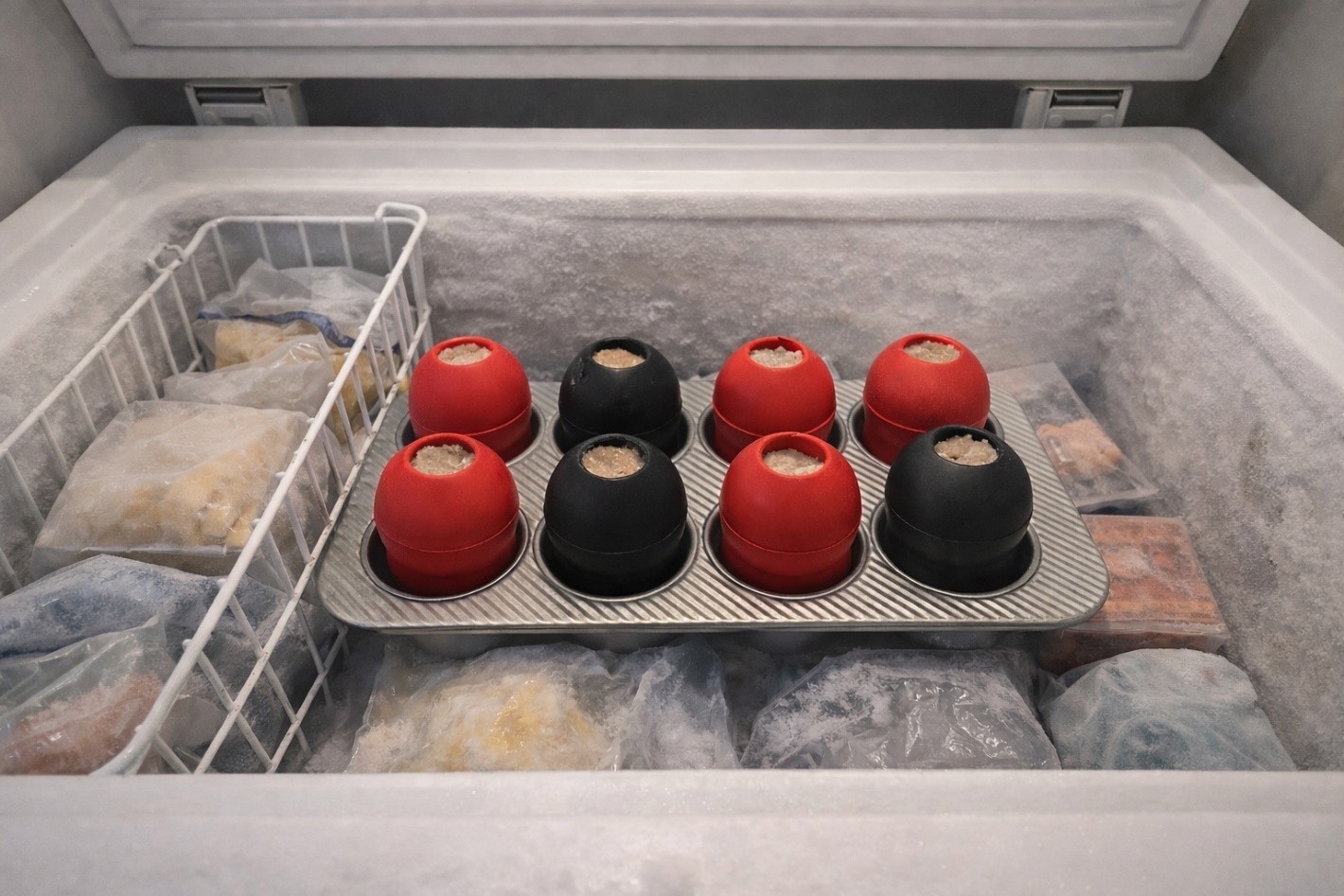
Batch Prep Tip: Use a Muffin Tin
If you have two or more dogs, you’ll likely end up with several Kongs.
A muffin tin makes batch prep easy:
- holds Kongs upright while freezing
- prevents leaks
- lets you prep multiple Kongs all at once
Especially helpful in multi-dog households.
The Rules That Make This Crate Training Tip Work
For the crate-training association to stick, the frozen Kong should be:
- used only in the crate
- removed when crate time ends
- never offered as a free-roaming chew
That exclusivity is the point.
The crate becomes the predictor of this experience.
Reference: Kong Size & Rubber Firmness Charts
Use the charts below to confirm the size and rubber firmness discussed earlier in this article.
If you’re between options, err slightly larger and slightly more durable.
Kong Size Reference (Quick Check)
| Dog Weight | Kong Size |
| Under 10 lbs. | XS |
| 10–20 lbs. | S |
| 20–35 lbs. | M |
| 35–60 lbs. | L |
| 60–90 lbs. | XL |
| 90+ lbs. | XXL |
Rule of thumb: If it looks even remotely swallowable, size up.
Kong Rubber Firmness Reference
| Dog Stage / Chewing Style | Kong Color |
| Puppy (teething) | (Pink / Blue) |
| Senior dogs | (Purple) |
| Most adult dogs | Classic (Red) |
| Strong / power chewers | Extreme (Black) |

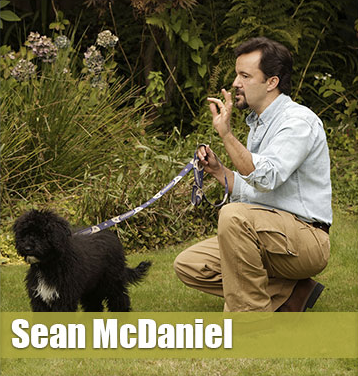
About the Author: Sean
I’ve been training people and dogs in Seattle for the last decade and a half. My main focus when working with clients every week in one-on-one, private lessons is to help people learn to get their dogs to a functional level so that they can actually enjoy spending time every day with their dog instead of stressing about their dog’s behavior issues.
Affiliate Program
Make money by referring people to the video course!
. . . . .
About Sean
I’ve been training people and dogs in Seattle for the last decade and a half. My main focus when working with clients every week in one-on-one, private lessons is to help people learn to get their dogs to a functional level so that they can actually enjoy spending time every day with their dog instead of stressing about their dog’s behavior issues.
Ask Sean a question!
If we use your question in the show, Sean will send you a coupon code for free access to the online video course!
If you have a question you’d like me to respond to on the show (and you want to hear yourself on a future episode) leave me a voice mail! 1 (844) 364-7929 or email me here.